

Seven Sisters
- Memoirs
Vertical Design Studio, SCI-Arc Graduate Studies
3GAX Fall Semester, Year 2, 2016
Group (2) Academic project
Pinar Seven, Nithya Subramaniam
Instructor - Eric Owen Moss
Proposed Site - New Moscow, Russia
Scale - 131,000sqm, New Sberbank
Tools Used - Maya, Rhino, Key Shot, Adobe Suite
The Seven Sisters are a group of seven skyscrapers in Moscow designed in the stalinist style of architecture
According the history there were originally 10 of these stylised buildings to be built and the last three of this set failed to be realised. The rules that these were based off were the idea of all the entries facing the Red Square, each building was designed such that they would be in clear sight of each other, public and private programs are housed separately and the public ones encase the courtyard. Maintaining these qualities was essential, therefore we used these elements and qualities to cater to the needs of our project.
Using the roof profiles from the seven sisters we generated a new roof- lining the old to the new. The grid adopted pays homage to the buildings that were never realised. Boulevard acts as a spine of the bank, functioning as major circulation. Roof continues to change as you proceed down the boulevard.
The programs are distributed to create an experience for every user of the building.


// The geometry of the building and how the grids and site boundaries are used to achieve the same.
While one grid faces the old Moscow city the other faces the new Moscow city.
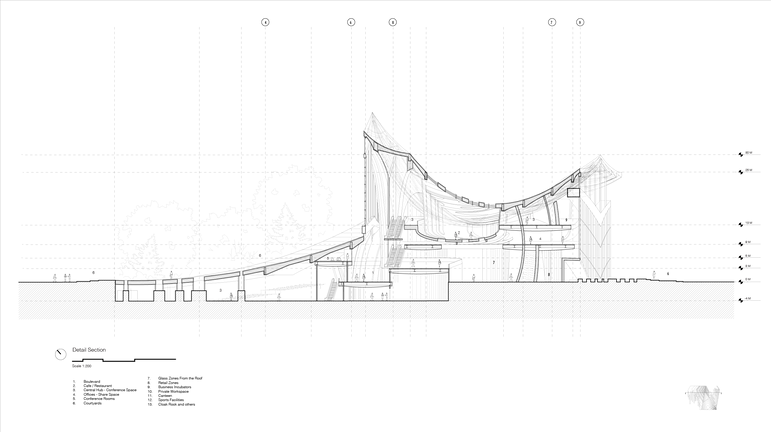
// This section above through the cross section shows the glass wall detail that lines the boulevard on either side.
It also shows the slab details and finned roof structure experienced from inside the building in contrast to what is seen from the outside.

// The building is framed within the site with the help of its context has brought about decisions of the grid layout, and even program orientation. The built form acts as an object and a public building.
Our design process entailed controlling and balancing its object like features with actual mandatory requirements. This can be seen through the program planning, the choice of material finishes which pays homage to the old seven sisters in a way, the placement of tectonic elements.
The material layering within the building is specifically seen in the roof and the slab elements.
This open section is cut through the boulevard. It helps reveal the splitting slabs, hanging slabs from the roof, ramps and circulation and the curved walls used to divided spaces.
The contoured roofs creates irregular peaks each from which the new or the old city can be viewed. It gives the same impression the seven sisters gives.

//View of the boulevard. Rendered in Key Shot. and illustrated in Photoshop
Boulevard developed using the overall idea of the old russia seven sisters and how these building were connected to each other.
The high cieling is also developed based on the inthe roof profiles seen in the seven sister buildings

// The view above shows the rise and fall of the roof and how it peels off the ground appearing one with its surroundings. The striations seen are public spaces for people to meet. They continue on the roof to let in light and forn winter gardens within the building.
Designed and modelled in Rhino and rendered in Maya and photoshop.

// The program is arranged such that it keeps all its view into the boulevard or towards the outside at all times. Doing this enables the segregation of the skin and their program pronounced, helping in understanding the planning of a bank. Shifting ramps along the boulevard spine allows visual connectivity, in an otherwise opaque program.
By creating open floor offices that are segregated from any other non personnel interference, helps the officials working in a bank of this kind have a better working environment.
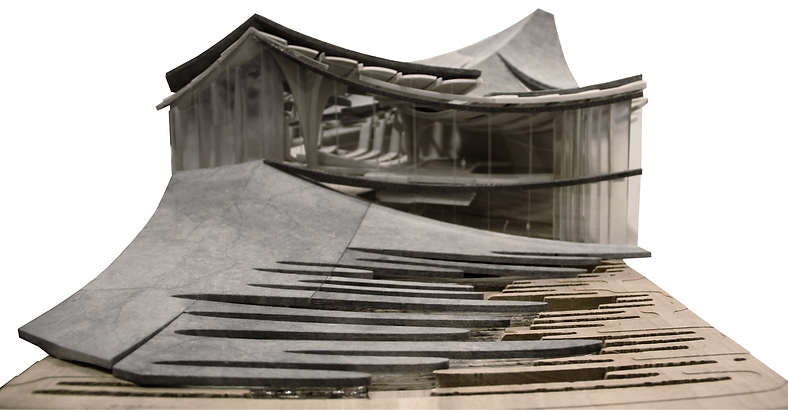
The model pictures alongside show the main features in the chunk model of the entire building. This chunk model attempts to expose the kind of structure that is designed to hold up the roof and the hanging slabs from the roof within the building. 3D printed in parts in an attempt to expose this form.
The Chunk is also picked to show maximum details adopted by the building to meet the conceptual and structural standards for this form.


//The three peaks seen in the roof structure imitate the 3 buildings that were not realised during Stalins reign. The primary ribs of the roof and the secondary structure between it running in two directions work together to create a framework and an overall finned structure below the roof.

// Model designed using 3D printed concrete roof, and etched acrylic used to represent the surrounding facade. The roof openings are created in locations where the conference hanging slabs are located to let in light.